Client Discovery Call: The 45-Minute Agenda
By Danial Pourgolab · 9 min read · July 2026
Most discovery calls are spent asking questions a form could have asked. How many pages? What platform is the current site on? Do you have brand guidelines? Meanwhile the things only a conversation can surface (why now, who really decides, what happened with the last agency) get squeezed into the final ten minutes or never come up at all. This guide flips that: collect the facts before the call, and spend all forty-five minutes on the questions that actually need a human on the line.
The 45-minute agenda
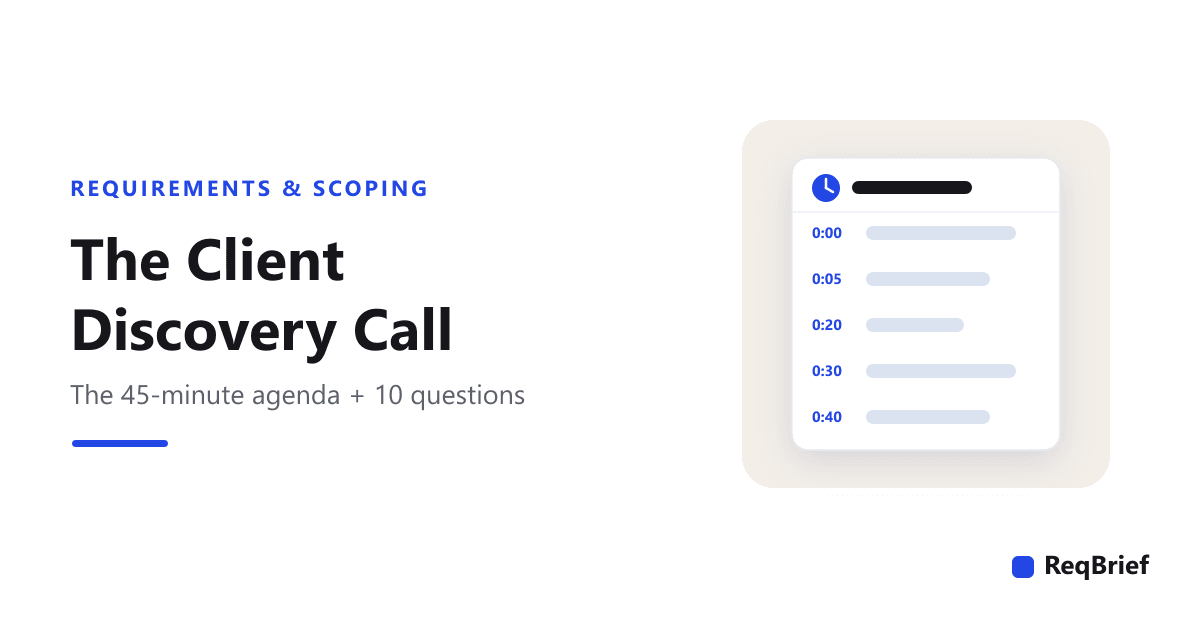
Here is the agenda in copy-paste form. Five blocks, timed. The timings are not decoration. The whole point is that stakes, people, and money each get protected minutes instead of whatever is left over.
DISCOVERY CALL AGENDA: 45 MINUTES

0:00–0:05  FRAME THE CALL
Say what the call is for and what it is not. Recap what you
already know from their enquiry / pre-call answers, so they
see you did the homework. Agree the outcome: "by the end of
this call we'll both know whether this is a fit."

0:05–0:20  STAKES & URGENCY
Why this project, why now, and what it costs them to do
nothing. This is where you learn whether the project is real.

0:20–0:30  PEOPLE & DECISIONS
Who is involved, who has opinions, who signs off, and what
happened the last time they tried to solve this.

0:30–0:40  MONEY & WORKING RELATIONSHIP
The budget conversation, what gets cut first if something has
to give, and how they like to work with vendors.

0:40–0:45  NEXT STEPS
Say exactly what happens next, who sends what, and by when.
Book the follow-up before you hang up.
Two notes on running it. First, the recap in the opening five minutes matters more than it looks: walking in already knowing their industry, their current site, and their stated goal signals competence before you have said anything clever, and it is only possible if you collect the facts beforehand -- which is the one rule the rest of this guide is built around. Second, the last five minutes are the most commonly botched. "I'll send over some thoughts" is not a next step. "You'll have a proposal Thursday; it will need fifteen minutes from you and a decision by the following Friday" is.
What a discovery call is (and what it isn't)
A discovery call is the first structured conversation with a prospective client, and it has exactly two jobs: you decide whether the project is real, winnable, and worth scoping, and the client decides whether they trust you with it. That is the whole assignment. It is not a requirements-gathering session, it is not a free consulting hour, and it is not a pitch. Requirements come later, in a structured interview or questionnaire; the pitch comes later still, in the proposal, once you know what you are proposing.
Treating discovery as requirements gathering fails in a specific, predictable way. Detailed requirements take hours to collect properly, so a 45-minute call collects them badly, and you end up doing unpaid scoping for a project you have not won, based on answers too thin to quote from. Treating it as a pitch fails differently: you talk for forty minutes, learn nothing, and write a proposal built on guesses.
The word "discovery" is borrowed on purpose. Product teams run product discovery to decide whether something is worth building before they build it; government teams run a formal discovery phase for the same reason. A discovery call is the agency-sales version of that move: reduce risk before you commit real resources.
The one rule: no live minutes on facts
Everything in this guide follows from a single distinction. A fact is anything with an objective answer: the page count, the hosting setup, the list of tools the site must connect to, whether logo files exist. A judgment question is anything where the value is in the follow-up: "why now?" is worthless as a form field and gold in conversation, because the third follow-up is where the real answer lives.
Facts belong in writing, before the call. Judgment belongs on the call. Run it the other way, as most agencies do, and you pay twice: the live minutes go to data entry a form could have done, and the judgment questions get rushed or skipped entirely.
Where the 45 minutes go
Getting the facts beforehand takes one email: a short questionnaire or structured interview sent when the call is booked. The web design questionnaire covers exactly what to ask in it. A useful side effect: whether the client completes it tells you something too. A prospect who cannot spend fifteen minutes answering questions before a call is showing you how the project will go.
The 10 questions worth asking live
These are the questions that fill blocks two, three, and four of the agenda above. None of them work as form fields. Every one of them earns its place because the honest answer usually arrives on the second or third follow-up, and only a conversation can follow up.
That "the real answer is in the follow-up" principle isn't unique to sales calls. It's the core of how UX researchers approach interviewing users: the first answer is rarely the complete one, so you probe rather than move on.
- 1"What happens if this project doesn't happen?" The single best qualifier there is. A real project has a cost of doing nothing: lost bookings, a competitor pulling ahead, a system falling over. If the answer is a shrug, you are looking at a nice-to-have, and nice-to-haves stall in procurement, drag through feedback rounds, and die in Q4 budget reviews. Price the shrug into your pipeline forecast.
- 2"Why now? What changed?" Projects have triggers: a funding round, a rebrand, a departure, an embarrassing sales call. The trigger tells you the real deadline, the real sponsor, and the real success measure, which are often not the ones in the enquiry email. "We've been meaning to for years" is an answer too: it means no trigger, and no trigger means no urgency when you need a decision in week three.
- 3"If we deliver everything we agree on and it still feels like a failure, what happened?" The inverted goal question, and it surfaces what the stated goal hides. Clients answer the standard "what does success look like?" with rehearsed lines; ask what failure looks like despite delivery and you hear the actual fear: "nobody internally uses it", "it looks like everyone else's site", "my boss hates it". That fear is the real acceptance criterion. Write it down.
- 4"Who else has an opinion on this, and whose opinion ends the debate?" Two separate questions deliberately fused, because the client will answer the first and you need the second. Every project has opinion-havers; only one person's opinion is final. If your day-to-day contact hesitates here, you have found the biggest risk in the project: a decision-maker who will appear for the first time in the last week, with feedback.
- 5"Have you tried to solve this before? What happened?" Past attempts are the highest-density information source available. A previous agency, an internal build, a DIY site-builder weekend: each failure tells you what this client under-resources, how they make decisions under pressure, and what "done" quietly means to them. No project is anyone's first attempt at the underlying problem; find the earlier attempts.
- 6"What went wrong with the last vendor you worked with?" Asked plainly, not as gossip. The answer tells you what this client is braced for (silence, overruns, being talked down to) so you can address it structurally in your proposal. It is also a character read: a client who describes the last three vendors as idiots, with no specifics and no share of responsibility, is describing the review you will get.
- 7"If budget forced a choice, what gets cut first?" Priority order is invisible in a feature list. Every item looks equally required until money is on the table. This question makes the client rank without the awkwardness of asking them to rank. Their instant answer ("the blog can wait, the booking flow cannot") is the skeleton of your phasing plan and your first defence against scope creep.
- 8"What's behind the deadline?" Deadlines come in two kinds: real ones with an event behind them (a trade show, a season, a contract expiry) and preference dates someone typed into a brief. You plan around them completely differently, and the client will not volunteer which kind theirs is, partly because they may not have asked themselves. A soft deadline discovered in week one is a scheduling detail; discovered in the final sprint, it is a crisis you staffed for unnecessarily.
- 9"What are you nervous about with this project?" Asked in the last third of the call, once there is some rapport. Clients carry unspoken worries (about the budget being approved, about their own job if it flops, about not understanding the technology) and those worries drive behaviour later: micro-management, delayed sign-offs, surprise stakeholders. Naming the worry now lets you design around it instead of colliding with it.
- 10"How do you want this to work between us?" Cadence, channel, and tone: weekly calls or async updates, Slack or email, blunt or diplomatic. It takes two minutes and prevents the slow-burn mismatch where you send tidy weekly summaries and they wanted a call, or you call and they wanted silence. It also closes the call on collaboration rather than interrogation, which is the impression you want them left with.
If some of these look familiar, that is by design. Several overlap with the questions to ask before starting a project. The difference is timing and depth: there, they are pre-project due diligence; here, they are live-call questions chosen specifically because their value is in the follow-up.
What not to ask on the call
Everything below has an objective answer, which means every minute spent on it live is a minute taken from the ten questions above. Collect these in writing, before the call: current site and platform, hosting and domain access, rough page or section list, tools and systems the project must integrate with, brand assets and guidelines, content status (who writes, what exists), examples of sites they like and dislike, and the budget range if they will give it in writing (many will, and the ones who won't have just told you where to spend block four).
✕ Facts collected on the call
Twenty-five minutes on page counts, hosting logins, and whether the logo exists as a vector. The "who signs off?" question gets ninety rushed seconds at the end. The proposal is built on a guess about the one thing that mattered.✓ Facts collected before the call
The factual answers arrived in writing two days ago. The call opens with a recap that proves you read them, then goes straight to stakes, people, and money. You hang up knowing whether the project is real, and the client hangs up impressed.Three answers that should slow you down
- 1Nobody can say what doing nothing costs. No cost of inaction means no urgency, and no urgency means every decision you need from them will take three weeks. It does not always mean walk away, but it does mean qualify harder, quote phasing rather than a big bang, and do not staff up on a verbal yes.
- 2Sign-off is "well, it's sort of a group thing." Committees do not approve websites; individuals do, eventually, late. If the decision structure has not been settled inside the client's own organisation, your timeline is fiction. Make naming a single approver a condition of the proposal. It is a reasonable ask, and how they react to it is itself information.
- 3Every previous vendor was terrible, no specifics offered. One bad agency experience is common and usually detailed ("they went quiet for six weeks"). A pattern of vague villains is different: it predicts how your chapter of the story gets told. If you proceed, proceed with tighter scope, written sign-offs at every milestone, and a deposit.
After the call: the write-up is the deliverable
A discovery call that lives only in your notebook is a conversation, not progress. Within twenty-four hours, write up what you heard (goal, stakes, stakeholders, constraints, open questions) and send it back to the client with one line: "this is what I understood; correct anything I got wrong." That write-up does three jobs at once: it catches misunderstandings while they are a one-line reply to fix, it shows the client what working with you feels like, and it becomes the first draft of the project brief, the document your proposal, estimate, and scope will all be built from. If you want the structure ready to paste into, the free project brief template has the sections laid out.
Walking in prepared, without the chase
The whole system rests on one thing: getting the factual answers before the call, without chasing a half-completed PDF around someone's inbox. This is the part ReqBrief automates. When the call is booked, you send the client a link; an AI interviews them one question at a time (goals, audience, scope, technical constraints, content) following up on thin answers the way you would, and hands you a structured brief before you dial in. You walk into the discovery call already holding the facts, and unlike a static form the interview adapts each question to the previous answer, so what comes back is complete instead of "TBD". Agencies use it exactly this way: interview first, 45 judgment-focused minutes second.
Run the agenda above with the facts already in hand, and the discovery call stops being a data-entry session with small talk. It becomes the thing it was supposed to be: forty-five minutes of finding out whether the project is real, and showing the client, by the quality of your questions, why they should give it to you.
Stop spending discovery calls on data entry. ReqBrief interviews your client before the call and hands you the facts, so your 45 minutes go to stakes, decisions, and winning the work.
Try ReqBrief free →Frequently asked questions
How long should a discovery call be?
Forty-five minutes is the sweet spot for most agency projects. Shorter than thirty and you only have time for facts, which a form could have collected; longer than an hour usually means the call is being used for requirements gathering, which belongs in a structured interview or questionnaire, not a live meeting. If you consistently need ninety minutes, the fix is not a longer call. It is moving the factual questions out of the call entirely.
What is the difference between a discovery call and a kickoff meeting?
A discovery call happens before anyone has committed: it is where you and a prospective client decide whether the project is real, roughly what it involves, and whether you want to work together. A kickoff meeting happens after the contract is signed: it confirms the plan (scope, timeline, stakeholders, first milestones) with the people who will deliver it. Mixing them up causes trouble in both directions: selling during kickoff wastes the team's time, and gathering detailed requirements during discovery means doing unpaid scoping for a project you may not win.
What questions should you ask on a discovery call?
Spend the call on questions whose value is in the follow-up: why the project matters now, what it costs the client to do nothing, what would make it a failure even if everything ships, who has opinions and who signs off, what happened the last time they tried to solve this, what gets cut first if budget forces a choice, and what is really behind the deadline. Factual questions (page counts, platforms, brand assets, integration lists) have objective answers and should be collected in writing before the call, so the live time goes to judgment.
Should discovery calls be free?
A 45-minute discovery call, yes. It is part of qualifying the work, and charging for it filters out good clients along with bad ones. What should not be free is the deep scoping that sometimes follows: audits, technical investigation, detailed specification. If a project needs days of analysis before you can quote it, that is a paid discovery phase with its own deliverable (usually the brief or scope document), and it is worth naming it as such rather than letting free "discovery" quietly expand into free consulting.