The Cost of Scope Creep, With Real Numbers
By Danial Pourgolab · 9 min read · July 2026
The project came in on scope and, on paper, on budget. Then you open the time tracker and see the truth the invoice hides: 40 billed hours, 52 actually worked. Those 12 unbilled hours didn't come from anywhere dramatic. They came from a dozen small "can you just…" favours you waved through to keep the client happy.
That gap is scope creep, and for an agency it isn't a scheduling annoyance. It's a P&L line item, one that never shows up as a line item. It hides inside "finishing the project," so it feels like diligence rather than a leak. Most owners can feel the margin bleeding without being able to point to where.
This post puts a real number on it. Not a scary statistic to make you nod, but the actual arithmetic of what one vague brief costs, why the visible rework is only the first layer, and a formula you can run on your own numbers this week. If you already know scope creep hurts, this is about learning exactly how much, so you can price it, prevent it, or both.
Why scope creep never shows up on the P&L
Agencies sell fixed-scope packages but deliver in hours. That mismatch is the whole problem. When a project is quoted at a flat fee, every extra hour you work comes straight out of the margin, because there's no mechanism to pass it on. A manufacturer who ships more units bills for more units. An agency that works more hours on a fixed-fee project just earns less per hour and calls it "the cost of doing business."
It isn't a rare problem, either. PMI's research on scope creep found that 52% of projects experience scope creep or uncontrolled change, up from 43% five years earlier. As work gets more complex, vague scope gets more expensive, and more common.
The reason it stays invisible is that the cost is diffuse. There's no single moment where you write off 12 hours. There are twelve separate moments where you write off one, each small enough to feel like goodwill rather than a loss. By the time you add them up at the end of the project, the money is already gone and the client is already anchored on the idea that "small changes are free." Owners who want to see the full picture usually have to reconstruct it after the fact, which is exactly why it never gets priced.
The real cost of one "small" change
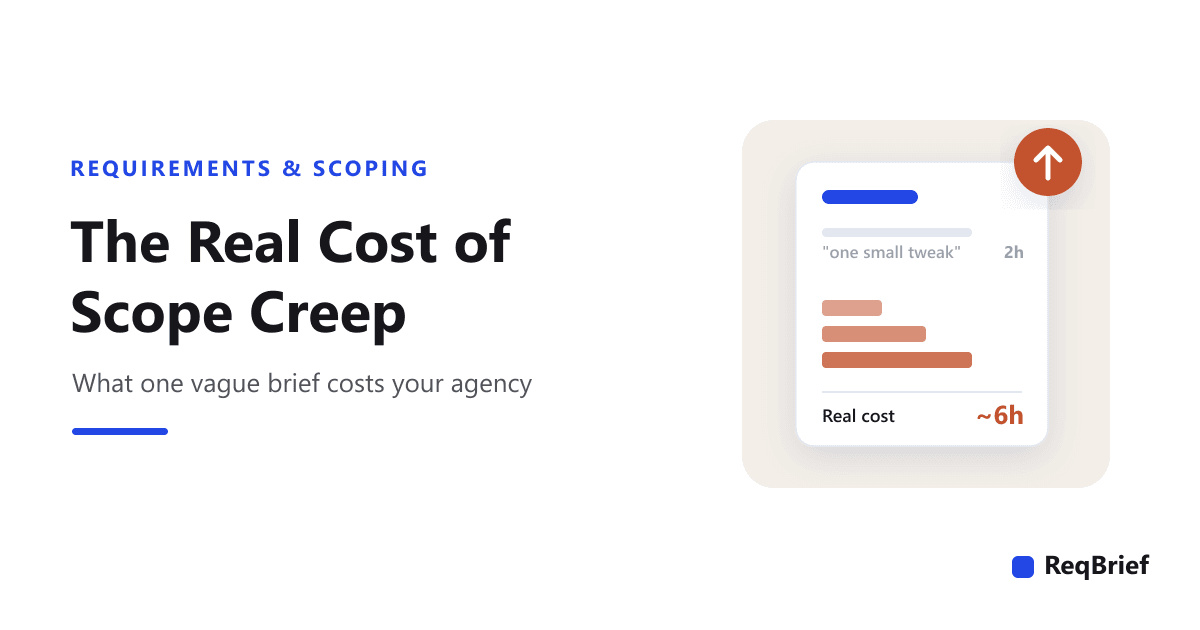
Take the change that feels the most harmless: the client asks for "just one small tweak" that's genuinely about two hours of work. You do it for free to keep the relationship warm. Here's what that free favour actually costs, layer by layer.
- 1The rework itself (2h). The visible part. Two hours of hands-on work you won't bill for. If this were the whole cost, scope creep would barely matter, most owners would happily eat two hours. It isn't the whole cost.
- 2Re-planning and coordination (1h). The change has to be understood, slotted into the schedule, communicated to whoever's building it, and checked once it's done. That coordination is real time from you or a PM, and it happens even for a "quick" change.
- 3The context-switch tax (1h). Pulling a developer or designer off focused work to handle an interruption costs more than the interruption. Refinding your place in complex work is slow, and the research on task-switching is consistent that it carries a real productivity penalty. Call it an hour of lost focus around a two-hour change.
- 4Opportunity cost (2h). Those hours weren't free capacity. They displaced billable work, or they pushed into evenings and eroded the team's slack for the next project. Every unbilled hour is an hour you could have sold or rested, and both have value.
Add them up and a "two-hour favour" is closer to six hours of real cost. At a blended rate of 80, that single free change quietly cost around 480, none of which appears on any invoice. Now multiply by the dozen small changes in a typical project, and the 12 unbilled hours from the opening aren't an accident. They're the predictable sum of a dozen decisions that each felt too small to charge for.
What one 'small' change actually costs
The costs that don't fit in a spreadsheet
Even six hours per change understates it, because the most expensive effects of scope creep aren't hours at all. They compound in ways a time tracker can't capture.
- 1Precedent. The first free change teaches the client that changes are free. The second request comes faster and larger, because you've quietly repriced your own work to zero. Every absorbed change makes the next one harder to charge for.
- 2Margin compounding the wrong way. Unbilled hours don't just lower one project's profit, they lower your effective rate across the whole studio. A team running at 15% unbilled overrun isn't a bit less profitable; it's working most of a day each week for free, every week.
- 3Morale and burnout. A project that keeps expanding with no extra fee is demoralising to work on. It reads to the team as "our time isn't valued," and the cost of that shows up later as slower work, turnover, and the projects nobody wants to staff.
- 4The reputation trap. Absorbing endless changes feels like great service, but it trains your best clients to expect an unsustainable level of it, and quietly signals that your time is negotiable. The agencies that hold scope firmly are usually the ones treated as partners, not vendors.
None of these fit neatly in a spreadsheet, which is exactly why they're underpriced. The hours you can measure are the tip; these are the mass under the waterline, and they're where the real damage accumulates over a year.
How to put a number on your own scope creep
You don't need the industry averages, you need yours, and they're within reach. Track unbilled hours for a single month, then run this:
✕ The vague version
"We lose a bit of money to scope creep, but it's the cost of keeping clients happy."✓ The version you can act on
Unbilled hours per project × blended hourly rate × projects per year. Example: 6h × 80 × 40 projects = 19,200 a year in unbilled work, before opportunity cost.Scope creep is only one of the ways a project ends up costing more than it was sold for, and it is rarely the largest: the wider picture is in the five hidden sources of extra hours that push projects over budget.
That number is almost always bigger than owners expect, and it's the number that changes decisions. Once you can say "scope creep costs this studio roughly 19k a year," the case for spending a few hours up front to scope projects tightly stops being a nice-to-have and becomes obvious math. The fix has to cost less than the leak, and upfront scoping almost always does.
It also reframes the conversation with clients. You're not being difficult when you scope a change, you're protecting a margin you can now quantify. That confidence is easier to hold when the alternative has a price tag on it.
Where the cost is actually created (and removed)
Here's the part that matters most: scope creep isn't created mid-project when the change request lands. It's created in week zero, in the gap between what the client pictured and what you wrote down. The change request is just that ambiguity finally coming due, with interest.
Which means the cheapest place to remove the cost is upstream, in the brief, before anyone is emotionally attached to an answer. A brief precise enough that two people can't read it two ways turns most "can you just…" requests into visible changes you can price, instead of assumptions you have to absorb. We covered the mechanics of that in how to prevent scope creep before the project starts, and what a scope-proof document looks like in three complete project brief examples.
The reason this doesn't happen consistently is that pulling that clarity out of a busy client is genuinely hard. A static intake form gets you three sentences and a logo; a real scoping conversation gets you the constraints and edge cases that scope creep feeds on, but nobody has time to run one on every project. That's the exact gap ReqBrief was built to close: it interviews your client one question at a time and turns their answers into a structured brief covering goals, user flow, constraints, open questions, and timeline, so scope gets defined before work starts, not renegotiated after.
Bottom line
Scope creep isn't a soft cost or a relationship tax. It's a measurable amount of money that leaves your studio every year through a dozen doors too small to notice. The visible rework is the least of it; the coordination, the context-switching, the opportunity cost, and the compounding effects on precedent and morale are where the real bill lands.
Put a number on it once and it stops being invisible. Then spend a fraction of that number on scoping projects tightly up front, and you convert an unpredictable leak into a controlled, priced part of the work. That's the whole trade: a few hours of clarity before the project, in exchange for the weeks of unbilled time it would otherwise cost you after.
Stop absorbing the cost of vague briefs. Let ReqBrief interview your client and hand back a structured, scope-proof brief before work starts.
Try ReqBrief free →Frequently asked questions
How much does scope creep cost an agency?
There's no single figure, but you can estimate your own. The direct cost is the unbilled rework hours multiplied by your blended hourly rate, and that is usually the smaller half. The larger half is indirect: coordination time, the context-switch tax on interrupted work, and the opportunity cost of hours that could have gone to billable work. A single "small" free change of two hours of rework typically costs closer to six hours once those are counted. Across a year of projects, that quietly becomes weeks of unbilled capacity and several points of lost margin.
How do you calculate the cost of scope creep?
Use a simple formula: average unbilled hours per project, times your blended hourly rate, times the number of projects you run per year. If a typical project absorbs 6 unbilled hours, your blended rate is 80, and you run 40 projects a year, that is 6 x 80 x 40 = 19,200 in unbilled work annually, before you count the opportunity cost of the billable work those hours displaced. Track unbilled hours for a month and the number stops being a guess.
Why is scope creep so expensive for agencies?
Because agency work is sold in fixed-scope packages but delivered in hours, so every unbilled hour comes straight out of the project's margin rather than being passed on. Scope creep also compounds: unbilled hours displace billable work, set a precedent that the next change will also be free, and erode the team's morale on a project that now feels like it will never end. The visible rework is only the first layer of the cost.
How do you reduce the cost of scope creep?
Move the cost upstream, where it is cheapest to remove. Most scope creep is born in a brief that was too vague to read one way, so the highest-leverage fix is a precise, signed-off brief with an explicit out-of-scope list before work starts. Then any later request is clearly a change to be priced, not an assumption to be absorbed. Standardising intake so every project is scoped the same way turns prevention into a habit rather than a heroic effort.