Why Projects Go Over Budget: 5 Hidden Causes
By Danial Pourgolab · 9 min read · July 2026
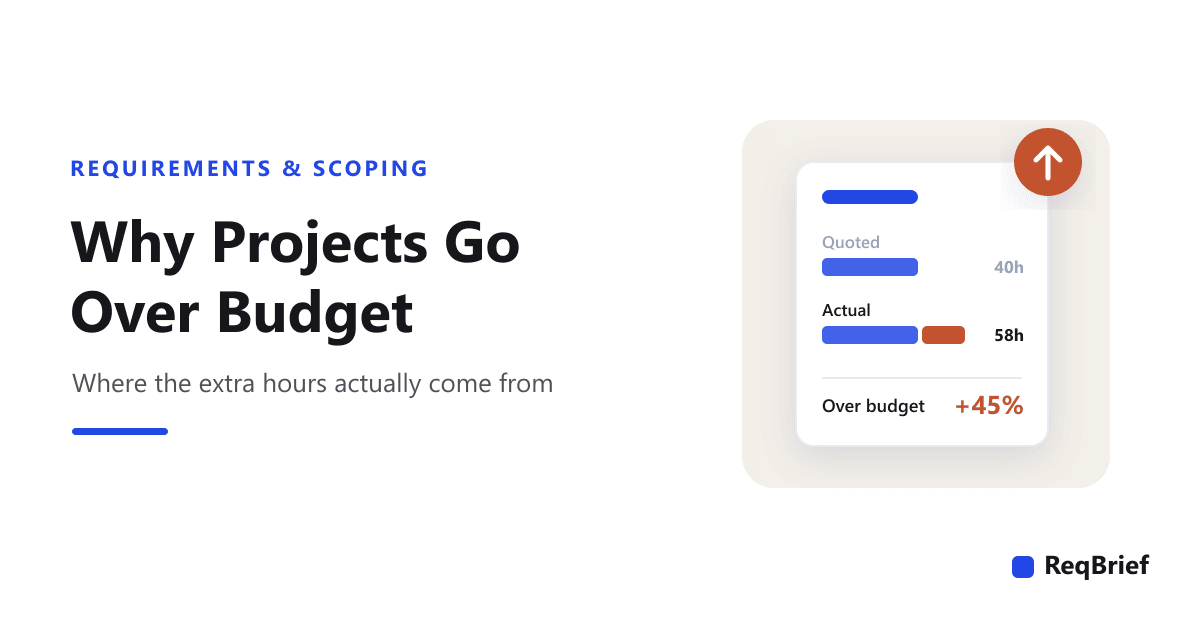
You quoted 40 hours. The project shipped at 58. Nobody was lazy, the client was not unreasonable, and there was no single moment where it went wrong. It just kept costing slightly more than it was supposed to, in ways that each looked like normal work.
That is what a budget overrun usually looks like from the inside: not a disaster, just a slow drift that only becomes visible when the project closes and the margin is smaller than the spreadsheet promised. And because it drifts rather than breaks, most agencies file it under "that is just how projects go" and quote the next one exactly the same way.
This post is about where those extra hours actually come from. Not the vague answer (scope creep) but the specific sources, with numbers, and the reason most of them were already baked in on the day you sent the quote. If you have ever finished a project on time and still lost money on it, this is where it went.
The overrun is decided before the work starts
The instinct when a project runs over is to look at delivery. Was the developer slow? Did the designer gold-plate it? Was the client difficult? Occasionally the answer is yes. Usually it is no, and the search is happening in the wrong place, because the hours were committed weeks earlier, in a document nobody thinks of as a financial decision: the quote.
A quote is a prediction, and you make it at the exact moment you know the least you will ever know about the project. You have a page of notes, a call, maybe a form the client filled in alone. Everything you discover afterwards, and you will discover a lot, lands on a budget that was already fixed. The project did not go over budget. The budget was too small when you wrote it, and the following six weeks simply proved it.
This is why estimating discipline alone does not fix overruns. You can be excellent at estimating the work you know about and still be wrong by 40 percent, because the problem is not your arithmetic. It is the requirements that were never in front of you when you did the arithmetic. Requirements engineering standards such as ISO/IEC/IEEE 29148 exist precisely because incomplete and ambiguous requirements are the expensive failure mode, and they are expensive in direct proportion to how late you find them.
The five hidden sources of extra hours
Take that 40-hour project that shipped at 58. Here is where the 18 extra hours actually came from, in the order they typically show up.
- 1Requirements found after the quote (7h). The largest single source, and the quietest. The client mentions in week two that it also needs to work in German, or that the booking system has to talk to the software they already use, or that the legal team has to sign off on any copy. None of it was hidden on purpose. It simply never came up, because nobody asked and the client did not know it mattered.
- 2An estimate that was one number. "Build the website: 40 hours." A single figure carries no information about risk, and it is almost always the optimistic case, because that is the version you can picture. Quoted as a range per discipline, the same project reads as 40 to 62 hours, and 58 stops being an overrun at all. It lands inside the number you gave.
- 3Rework from a brief two people read differently (5h). The brief said "a simple booking flow." You built simple. The client meant simple for their staff, with an admin view, manual overrides, and a way to block out holidays. Nobody was wrong, the sentence was. Rework from ambiguity is expensive because it arrives after the work is already built and has to be unpicked.
- 4Review and approval drag (4h). You budgeted two rounds of feedback. You got five, spread over three weeks, from two people who disagreed with each other. The hours here are not just the edits: they are the chasing, the re-explaining, and the cost of picking the project back up each time it stalls and restarts.
- 5Unbilled "quick" changes (2h). The classic. Each one is genuinely small, each one is waved through to keep the relationship warm, and together they are a workday you gave away. This is the part everyone calls scope creep, and it is real, but notice that it is the smallest slice of the overrun, not the biggest.
Four of those five add hours you could count if you tracked them. The second one is different in kind: it does not add a single hour to the work, it removes the room you had to absorb the others. A range would have carried the risk. One number gave you nowhere to put it.
Where a 45 percent overrun comes from
Why the quote was already wrong when you sent it
Agencies quote from whatever the client managed to write down unprompted, which is the thinnest description of the project that will ever exist. A client writing a brief alone describes what they can picture: the look, the pages, the feeling. They leave out the things that actually drive the hours, because those things are invisible to them. Nobody writes "we will need three rounds of legal review" in a paragraph about wanting a fresh, modern site.
✕ What you quote from
"We need a new website for our clinic. Modern look, easy to update, and patients should be able to book online. Budget is flexible for the right partner."✓ What you needed to quote accurately
Three locations with different opening hours. Booking must sync with the existing practice-management system. Two staff need admin access. Content is coming from the practice manager, who is on leave for three weeks. Every patient-facing page needs sign-off from the lead physician.Both describe the same project. One of them is quotable. The distance between them is the overrun, and it exists because the questions that close it were never asked. This is the reasoning behind treating discovery as a distinct phase rather than a formality: the UK government's Service Manual on the discovery phase frames it as the work of understanding the problem before committing to a solution, and the commitment agencies make earliest is the price.
The uncomfortable version of this: if you quote before discovery, you are not pricing the project. You are pricing your optimism about the project, and then finding out what you actually sold.
How to quote so the budget survives the project
Every fix below moves accuracy earlier, which is the only place it is cheap. None of them require you to be tougher with clients, which is the advice that usually gets handed out and rarely gets followed.
- 1Do the discovery before the number, not after the signature. Even 30 focused minutes of questions before quoting changes what you quote. The goal is not a full requirements document, it is finding the two or three facts that would move the estimate, which are almost always about integrations, approvals, and who else has an opinion.
- 2Quote ranges, broken down by discipline. A range is not hedging, it is honest information about risk, and it gives you somewhere to put the unknowns instead of pretending they are not there. It also makes the expensive parts of the project visible to the client before they are a surprise.
- 3Budget the review rounds and name the number. Write "includes two rounds of consolidated feedback" into the quote. This costs nothing to say up front and is nearly impossible to introduce halfway through. It also quietly tells the client to consolidate their feedback, which is where most of the drag comes from.
- 4Write the out-of-scope list. The in-scope list is a wish. The out-of-scope list is the one that saves you, because it turns "I assumed that was included" into a conversation you have before the work rather than after the invoice. Three lines is enough.
- 5Price changes as changes, from the first one. The first free change sets the price of every change after it. Pricing the first small one is much easier than pricing the fourth, and it is the moment that decides whether the rest of the project stays inside the budget.
If you only do one, do the first. Late requirements and ambiguous wording were the two biggest slices of the overrun, and both are removed by asking better questions before the price is fixed. We covered the mechanics of estimating in ranges in how to break a project into tasks and estimate the hours, and the questions worth asking live in the 45-minute discovery call agenda.
The part that makes this hard in practice
Everything above is obvious. It is also the first thing that gets dropped, because running real discovery on every enquiry does not scale. Most of the projects you scope will never be signed, so spending an hour interviewing every prospect is time you cannot bill and cannot get back. The rational response is to quote fast from a thin brief, which is exactly the behaviour that produces the overrun.
So agencies reach for a shortcut, and the usual one is a form. But a static intake form cannot do the thing that actually matters here. It collects the answers the client already knew to give and never asks the follow-up question that surfaces the German-language requirement or the legal sign-off. A form is a faster way to receive the same thin brief.
That gap is what ReqBrief was built to close. You send the client a link and an AI interviews them one question at a time, following up whenever an answer is vague, then hands you back a structured brief covering goals, scope, constraints, timeline, and the open questions that still need an answer. You get the discovery that makes a quote accurate without spending your own hour on a project you might not win.
Bottom line
Projects do not go over budget in week four. They go over budget on the day you priced them, and the following weeks are just the process of finding out. The extra hours come from requirements you had no way of knowing about, wording that two people read two ways, approvals nobody counted, and a single-number estimate with no room in it. Scope creep, the thing that gets blamed, is the smallest piece.
Which means the lever is not working harder inside the project. It is knowing more before you commit to a number. An hour of real questions before the quote is worth more than any amount of discipline afterwards, because it is the only point where the budget is still yours to set. Once you have quoted 40, the project is going to take what it takes.
Quote from a real brief, not a paragraph. Let ReqBrief interview your client and hand back a structured brief before you put a number on the work.
Try ReqBrief free →Frequently asked questions
Why do projects go over budget?
Because the budget is set at the moment you know least about the project. Most overruns trace back to five things, and four of them are decided before anyone starts building: requirements the client never mentioned until work was underway, an estimate given as a single number with no room in it, rework caused by a brief that two people read differently, review and approval cycles nobody budgeted for, and small unbilled changes absorbed to keep the client happy. Only the last of those is really a delivery problem. The rest are intake problems that surface later.
How much do projects typically go over budget?
There is no single trustworthy figure for agency work, because most studios never measure it: overrun hours get absorbed into "finishing the project" rather than logged as a variance. The number that matters is your own, and it takes one month to find. Compare quoted hours against tracked hours on every project you close, and express the gap as a percentage. A 40-hour project delivered in 58 hours is 45 percent over. Once you have that percentage across five or six projects, you can price it instead of guessing at it.
How do you stop a project from going over budget?
Move the accuracy upstream, into the quote. Run discovery before you price the work rather than after you win it, so you are estimating against real requirements instead of a paragraph the client wrote alone. Quote in ranges broken down by discipline, so the risk in each part of the work is visible rather than averaged away into one optimistic number. Name the number of review rounds included. Write an explicit out-of-scope list. Then price change requests as changes rather than absorbing them, which keeps the budget honest for the rest of the project.
Is going over budget the same as scope creep?
No. Scope creep is one cause of budget overrun, not the whole of it. Scope creep is work that was added after the project started. A project can also run over with no scope change at all: the estimate was too optimistic, the requirements were misread, or the client took three weeks to approve something you had budgeted three days for. Treating every overrun as scope creep leads agencies to police their clients when the real fix is usually a more accurate quote and a tighter brief.